What is life?
The Odyssey of Existence: Conception, Living, and the BeyondWhat is “Life”? The answer shifts profoundly depending on the lens through which we look. To a biologist, it is a sophisticated cellular marvel—an automated chemical process starting from a single microscopic spark and evolving into a living, breathing organism. To Buddhist philosophy, however, life is far more than a mere physical mechanism. It is an uninterrupted, ever-flowing stream of mind and matter (Nama-Rupa), propelled through an endless cosmic cycle by the forces of ignorance and craving.
How do we begin? Why and how must we live? And what happens to us when our physical bodies cease to function? These are the eternal questions that humanity has asked since the dawn of consciousness. To comprehend the deep reality of our existence, we break down this journey into three distinct phases.
From Conception to Birth
Daru Pilisindime Sita Upatha Dakva
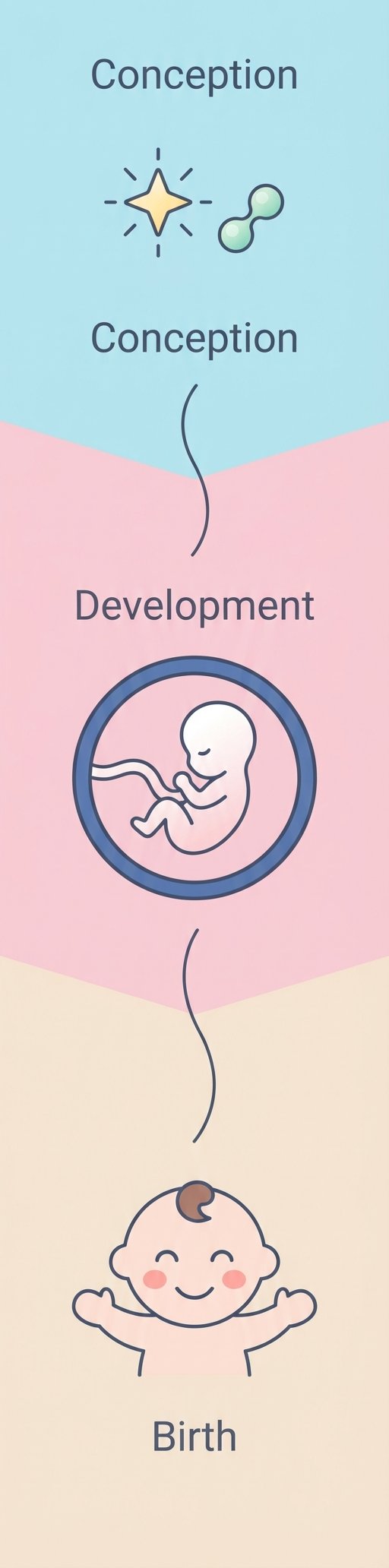
The initiation of human life is a profound intersection of material chemistry and metaphysical transition. Buddhist doctrine states that for a successful conception (Pratisandhi) to occur, three components must align: the physical union of the parents, the mother’s fertility window, and the presence of a transitioning consciousness (Gandhabba) ready to take root in the womb. Modern embryology mirrors this complexity, viewing it as a cellular miracle where a single sperm and egg fuse to create a unique genomic blueprint (Zygote).
The Claustrophobia of the Womb: The Cauldron Analogy
Classical Buddhist commentaries paint a stark, uncompromising picture of the nine months spent in the maternal womb, coining the experience as the “Suffering of Womb-Existence” (Garbha Vasa Duka). In these texts, the uterus is metaphorically compared to the narrow, boiling confines of the Iron-Cauldron Hell (Lohakumbu Niraya):
- The Prison of Absolute Confinement: As the fetus grows, it is forced into a rigid fetal position—knees pressed against the chest, limbs restricted, trapped in a narrow, unyielding space for months.
- The Trauma of External Shocks: Ancient texts describe how the fetus is subjected to constant internal turbulence. When the mother drinks freezing water, swallows scalding food, moves abruptly, or trips, the impact is experienced by the fragile consciousness as a cataclysmic shock—akin to being crushed by rocks or plunged into icy currents.
The Medical Reality: Nature’s Ultimate Life-Support Sanctuary
Modern medicine observes this identical process through an evolutionary lens, recognizing the uterus not as a chamber of torture, but as a marvel of biological engineering. Science shows that nature provides a highly optimized, automated life-support system (Jiva Adhara Paddhati):
- The Amniotic Shield (Ulba Dravaya): The fetus floats safely within a sterile, temperature-controlled fluid environment. This liquid acts as a hydraulic shock absorber, dampening kinetic impacts. When the mother moves or trips, the fluid dissipates the energy, translating a harsh bump into a gentle, fluid sway.
- The Placental Highway (Vaidamaha): The fetus does not breathe or digest traditionally. The placenta and umbilical cord act as a seamless lung, kidney, and nutrient filter, supplying purified oxygen and rich nutrients directly into the fetal bloodstream while isolating harmful pathogens.
Birth: The First Great Crisis
The process of delivery (Prasutiya) is recognized by both frameworks as an intensely stressful event. Forcing through the narrow birth canal subjects the infant to severe physical pressure and trauma. Yet, as the child breaks free into the open air, taking its very first independent breath, the curtain rises on the second act of existence: the reality of living.
Living
Jivat Vima
Once born, living becomes a rich tapestry of sensory inputs, emotional highs, deep lows, victories, and defeats. Biologically, it is a dynamic battle against decay. Philosophically, it is an unprecedented, highly rare opportunity to shape one’s ultimate destiny.
The Biological View: The Chemical Battle for Equilibrium
To science, living is defined by continuous, active cellular maintenance:
- Homeostasis (Samasthithiya): No matter how volatile the external environment becomes, the brain and metabolic systems work tirelessly to maintain a constant internal temperature, pH balance, and chemical equilibrium.
- Perception and Adaptation: Human life is distinguished by a highly developed nervous system. Through our five senses, paired with advanced cognitive intellect, we parse the external world, solve complex survival problems, and dynamically adapt to our environment.
The Buddhist View: Karma and the Traps of Impermanence
Buddhism emphasizes that being born as a human is an exceptionally rare, precious privilege—the attainment of a “Rare Human State” (Durlabha Minisat Bava). However, this precious state is bound by inescapable universal laws:
- The Nature of Impermanence (Anicca Svarupaya): No state of worldly pleasure, health, or youth can be sustained indefinitely. Things change against our wishes and slide out of our control. Realizing that the things we cling to are fundamentally unstable reveals the ultimate unsatisfactoriness of mundane life.
- The Fabric of Conditioned Reality (Sankhata Dhammo): Everything we experience, including our body and mind, is “Sankhata”—meaning it is constructed, put together, and maintained by temporary causes and conditions. The five aggregates of existence (Pancha Upadanaskhandha) are in a state of constant, rapid flux. When the underlying causes dissolve, the conditioned constructs inevitably break apart.
- The Purpose of an Enlightened Life: Buddhism teaches that merely eating, sleeping, and reproducing is a basic animal existence. A human life achieves true value only when a person recognizes these Anicca and Sankhata realities, using their advanced intellect to practice moral restraint (Sila), mental cultivation (Samadhi), and genuine wisdom (Pragna).



Life After Death
Maranin Mathu Jivitaya
From a material standpoint, death is a hard stop. From a spiritual standpoint, it is a mere transition—a changing of garments for the continuous stream of consciousness.
The Scientific Frontier: Conservation and Anomalies
Traditional medical science defines death as the permanent cessation of cardiac and brain activity, leading to cellular decomposition. However, contemporary research continues to press against the boundaries of this definition:
- The Law of Conservation of Energy: Physics dictates that energy cannot be destroyed, only transformed. What happens to the distinct bio-electrical and cognitive energy that once animated the human body remains a profound scientific mystery.
- Near-Death Experiences (Maranasanna Athdakim): Studies on patients who survived clinical death often reveal highly structured, cross-cultural phenomena—such as moving through tunnels of light or experiencing out-of-body awareness—which challenge traditional neurological explanations.
- Empirical Reincarnation Studies: Respected researchers, such as Professor Ian Stevenson, spent decades documenting thousands of verified cases of young children who possessed precise, verifiable memories of past lives (Punarubhavaya), presenting data that science cannot easily dismiss.
The Buddhist Mechanics: The Continuity of Mind and Intention
Buddhism explains that while the physical body (Rupa) fails and decays at death, the mental energy stream (Nama) does not stop if it is driven by the fuel of ignorance and craving:
- The Terminal and Initial Minds: At the exact moment the final thought-moment of the current life—the “Decease Mind” (Chuti Sitha)—ceases, it conditions the immediate arising of the very first thought-moment of the next life—the “Reconnection Mind” (Pratisandhi Sitha). There is no temporal gap or intermediate soul wandering between the two.
- The Steering Force of Intention (Karma Shakthiya): In the final moments of life, past actions manifest before the mind as visions or symbols (Karma Nimitta / Gati Nimitta). This mental state dictates whether the subsequent rebirth occurs in a plane of happiness (Sugati), such as the human or celestial realms, or a plane of misery (Dugati), such as the animal or depressive realms.
The Trap of Samsara and the Permanent Solution
(Samsaraye Ugula saha Sadathanika Visaduma)
In this human life, you are fully permitted to experience the entire spectrum of worldly dualities. You are allowed to be greedy (Loba) and possessive, or conversely, to step forward as a great, selfless giver (Danapahiya). You are allowed to burn with intense anger (Dvesha) at one moment, and completely submerge yourself in loving and being loved (Adharaya) the next. You possess the freedom to make completely foolish, short-sighted decisions (Moha), or to walk the refined path of a wise sage (Pragnavanta). On the surface, drifting through this colorful kaleidoscope of conflicting human experiences feels like a beautiful, highly entertaining, and immersive game.
But what is the hidden catch (Bayanakama Rahasa)?
While you are entirely free to navigate these personal choices, there is a strict boundary you must never cross: you cannot allow your actions to fall into systemic immorality or unwholesomeness (Akusala). Specifically, you must actively protect your mind and body from committing the Ten Unfair Immoral Acts (Dasa Akusl)—which span physical violence (Pranaghathaya), theft (Adattadaniya), sexual misconduct (Kamesumichchacharaya), lying (Musavadaya), harsh speech (Parushavadaya), slandering (Pisunavadaya), frivolous chatter (Samphappralapaya), covetousness (Abhijjhava), ill-will (Vyapadaya), and holding wrong views (Michchaditthiya). The brutal catches of natural mechanics dictate that even if you perform these ten immoral actions strictly for temporary fun, boredom, or out of pure ignorance, they possess a heavy karmic gravity that will relentlessly drag your consciousness down into lower, highly agonizing, and undesired planes of existence—namely the four lower realms of absolute suffering (Sathara Apaya). The depths of confinement in those lower planes hold an immense, unspeakable amount of raw torment.
So, would simply turning over a new leaf and becoming an exceptionally generous, kind, and universally loved person solve this foundational problem forever?
For the immediate time being, yes. Your positive, wholesome intentions (Kusala Karma) will bear sweet fruit, automatically elevating you into safe, pleasurable, and heavenly planes of existence (Sugati). However, the systemic flaw remains: by your very baseline human nature, the deep underlying roots of greed, anger, and stupidity (Loba, Dvesha, Moha) have not been completely uprooted. Because those fires still smolder silently in your subconscious mind, you are perpetually vulnerable to making critical, sudden mistakes under high emotional pressure. A single unwholesome slip-up, driven by a momentary flash of blind rage or deep illusion, is enough to restart the cycle and drag you right back down into those terrifying, undergirded planes of intense misery.
As humans, we constantly live under the illusion that we can permanently claim and manufacture happiness exactly how we want, when we want. Yet, look closely at your own history: the moment you finally obtain the exact thing you desperately chased, your inner desires immediately shift. You find yourself wishing that the circumstance had manifested in a slightly different style, a different shade, or under a different timeline. The harsh systemic reality is that you can never permanently satisfy both desires simultaneously because your micro-wants alter from second to second. This is the true, inescapable profile of Impermanence (Anicca Svarupaya)—nothing can ever be held in a state of static perfection to give you unending satisfaction.
When things inevitably fall apart, we desperately look for an answer. We either confidently claim the victory as a product of our ego, or we bitterly shift the blame (Blame) onto our passing anger, our momentary stupidity, or some external bad luck, foolishly comforting ourselves with the whisper: “Next time, it will all turn out alright.” The absolute psychological truth is that it never has turned out perfectly, and within a conditioned universe, it never will.
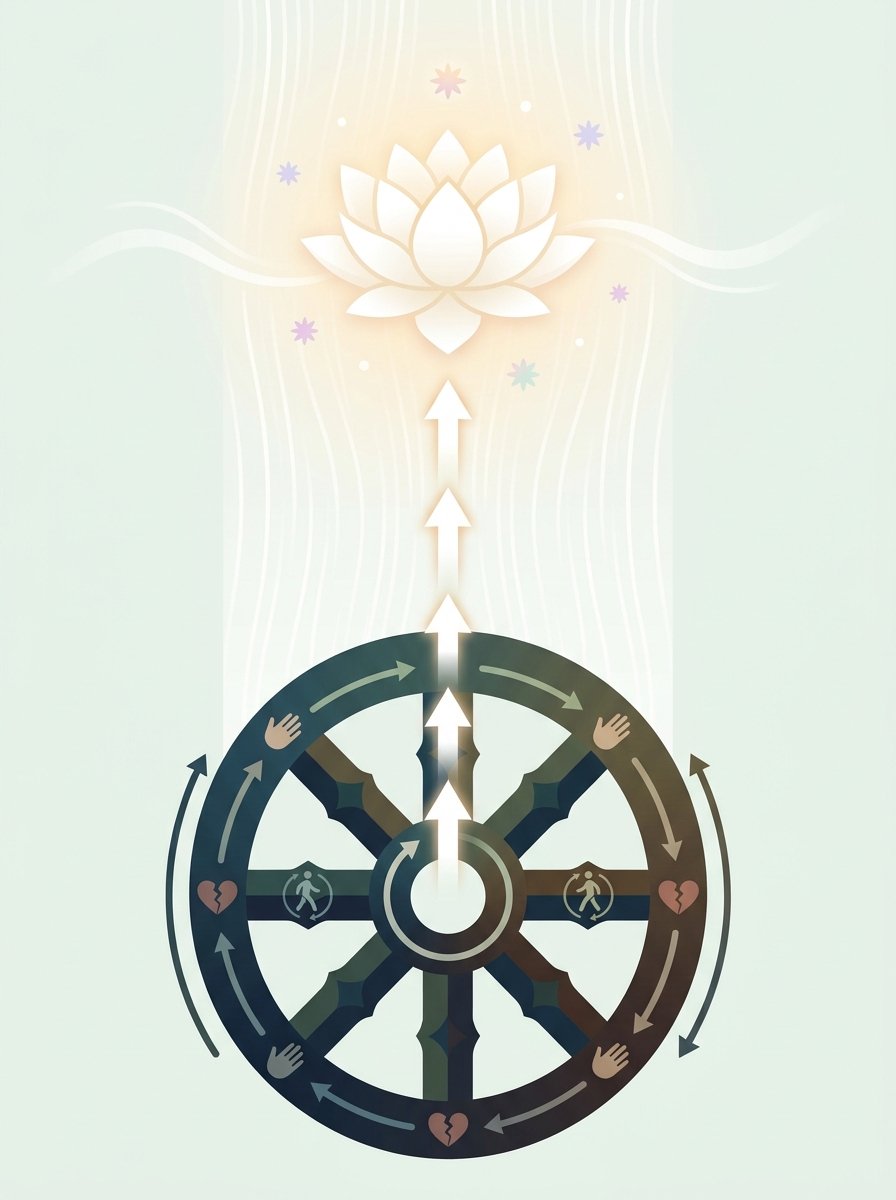
This realization is precisely why a permanent, unshakeable solution to this vicious, repetitive cycle (Samsara Chakra) is so deeply desired and highly sought after by those who see the trap. It is the exact reason why Gautama Samma Sambuddha, alongside the infinite lineage of fully enlightened Buddhas who walked the Earth before him, bypassed all temporary worldly patches and explicitly advised the realization of Nibbana. They pointed to the deathless shore because it is the only true exit door capable of completely disconnecting the mind from the spinning wheel of conditioned decay, guaranteeing absolute, permanent freedom.
Conclusion: The Path Beyond the Cycle
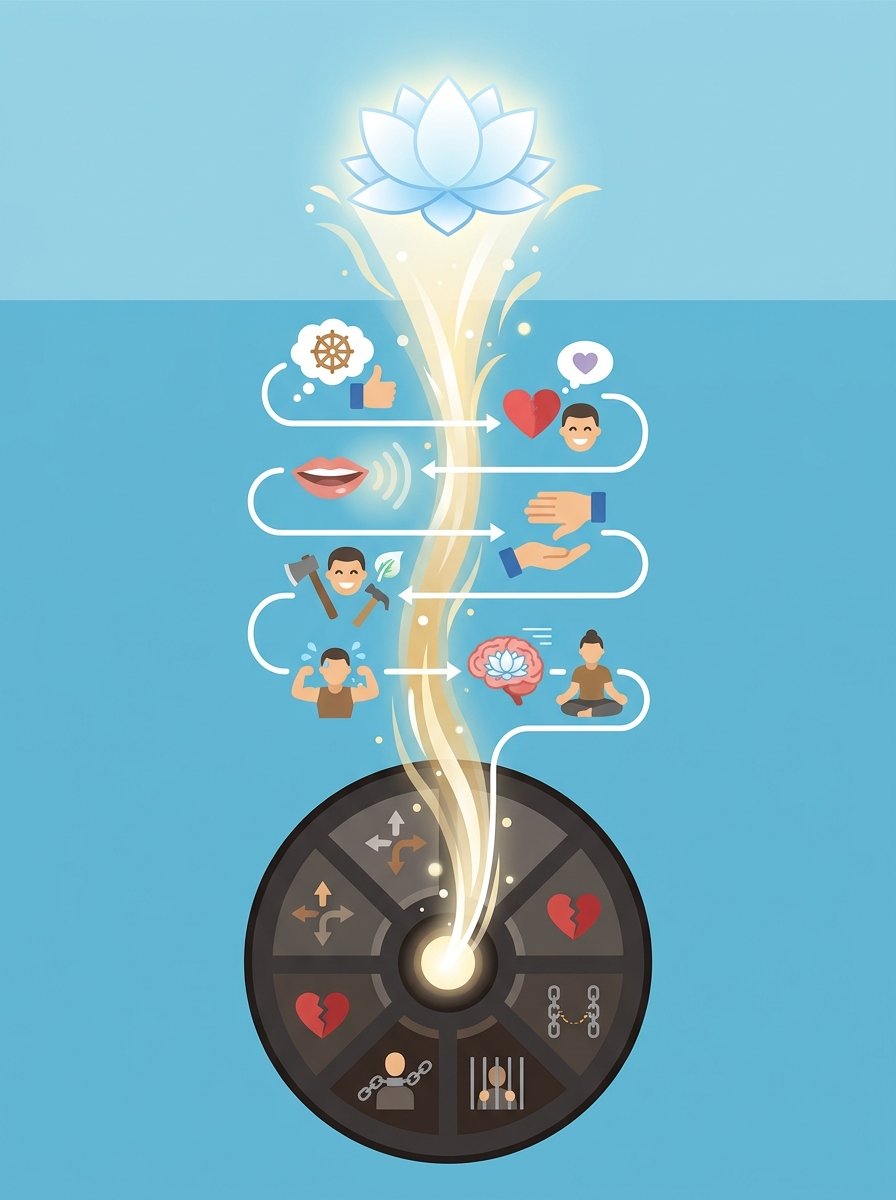
The journey from conception to birth, living to death, and death to rebirth forms an ancient, spinning vortex. This perpetual, cyclic trap is known as the Cycle of Rebirth (Samsara).
The Inevitability of Suffering
To remain trapped within the Sankhata (conditioned) universe is to accept a contract with inevitable suffering. Because everything built upon conditions must eventually decay, searching for permanent happiness within the cycle of Samsara is mathematically and spiritually impossible.
The Ultimate Ultimate Reality (Paramartha Dhamma)
To show the exit from this trap, Buddhist metaphysics outlines the four ultimate realities of the universe, known as the Highest Realities (Paramartha Dhamma):
- Chitta (The fundamental consciousness)
- Chetasika (The mental factors and emotions that color the mind)
- Rupa (Physical matter and material forms)
- Nibbana (The unconditioned liberation)
While the first three realities (Chitta, Chetasika, Rupa) are entirely Sankhata—meaning they are dynamic, caused, and unstable—the fourth reality, Nibbana, stands completely apart. Nibbana is the Unconditioned Reality (Asankhata Dhamma). It is not born, it does not change, it does not depend on causes, and it never decays. It is the absolute exit from the spinning wheel of Samsara.
The Nature of the Unconditioned (Asankhata)
Nibbana is the ultimate spiritual wellness. It is described as a state of supreme peace and deathless reality (Amara). By completely extinguishing the fires of greed, hatred, and delusion, the mind steps out of the causal stream of time, mass, and suffering, achieving a permanent, unshakeable bliss.
The Way to the Exit
To experience this unconditioned freedom, one must follow the blueprint laid out by the Buddha: the Four Noble Truths (Chaturarya Sathyaya), realized practically via the Noble Eightfold Path (Arya Ashtangika Margaya).
By cultivating Right View (Samma Ditthi) through to Right Concentration (Samma Samadhi), an individual progressively refines their morality, stabilizes their mind, and awakens the sharp sword of pristine insight. It is through this practical, urgent training that a person shatters the illusions of the conditioned world, steps off the wheel of birth and death, and claims the timeless, radiant peace of Nibbana.
මුල මැද අග
ජීවිතය සහ මරණ හතර
නාම රූප පරිච්ඡේදය
හමුවීමේ සතුට
සිඟමනේ බුදුදහම යදිනට වූ කාලයක් විය…
කාලාන්තරයක්, නිවැරදිව තෙරුම් යන්න බුදුදහම වටහාගන්නට, සිඟමන් යදිනන් සේ පිය උරුමය සොයා රස්තියාදු ගැසූ කාලයක් විය.
දහමේ දැන ගතයුතු යමක් ඇතිද එය නිරවුල්ව දේශනා කල හැකි උතුම් ආර්යයන් අද ලොව පහල වී ඇත.
මේ උතුම් ක්ෂණ සම්පත්තිය මඟ නොහැර සියල්ලෝ තම දහම් පිපාසය සංසිදුවා ගනිත්වා!!!